The History of Ankaran: Where Does the Name Ankaran Come From?
Did you know that the name Ankaran also appears in other parts of Italy and is linked to Roman estates, monasteries, and ancient transport routes? Discover the stories and theories behind the name of this coastal place.
The wider area of Ankaran was settled very early. This is clearly evidenced by prehistoric hillforts (castellieri), such as Kaštelir above Elerji, Sermin, Tinjan, Škofije above Dekani, Markovec, and others, as well as numerous discovered Roman settlement remains, especially villae rusticae. The settlement of this area was not accidental, but closely linked to its favourable location, proximity to the sea, and important transport routes.
Above Ankaran, near Božiči, the remains of a fortification have been preserved, from which traffic along the Roman road Via Flavia—connecting Trieste (Tergeste) and Pula (Pola)—was likely monitored. The importance of this corridor is further confirmed by archaeological discoveries from 2002, when remains of road paving were found at the Ankaran crossroads Bivje (Bivio). The road was paved with river pebbles and continued towards the Rižana River, where remains of a Roman bridge are also believed to exist. Excavations at Sermin revealed large quantities of early Roman material, confirming relatively early and continuous settlement in the area near the mouth of the Rižana River—dating back to prehistoric times.
In this historically vibrant area, the place name Ankaran also developed, although its origin is not definitively explained. Several theories exist. One of the most widely accepted interpretations today is based on a note by A. Tomasich (1886), linking the name to the abbot of a Benedictine monastery, supposedly named Ancarano. Another explanation, proposed by C. Combi (1890), suggests that Ancarano was a common name for Roman estates, indicating a connection to ancient ownership and land organization.
The discussion on the origin of the name was further expanded in 1921 by Giannandrea Gravisi, who pointed out that the name Ancarano is not unique. He listed several places with the same or very similar names: Ancarano in Abruzzo near Teramo, settlements near Monte Romano (Rome), near Norcia in Umbria, near Rivergaro in the Piacenza area, and Angarano near Bassano. Such widespread occurrence suggests that the explanation cannot rely solely on local characteristics, but must consider a broader cultural and linguistic context.
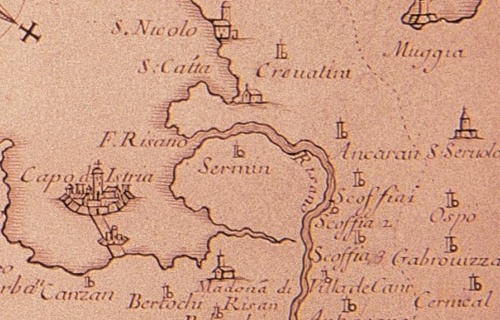
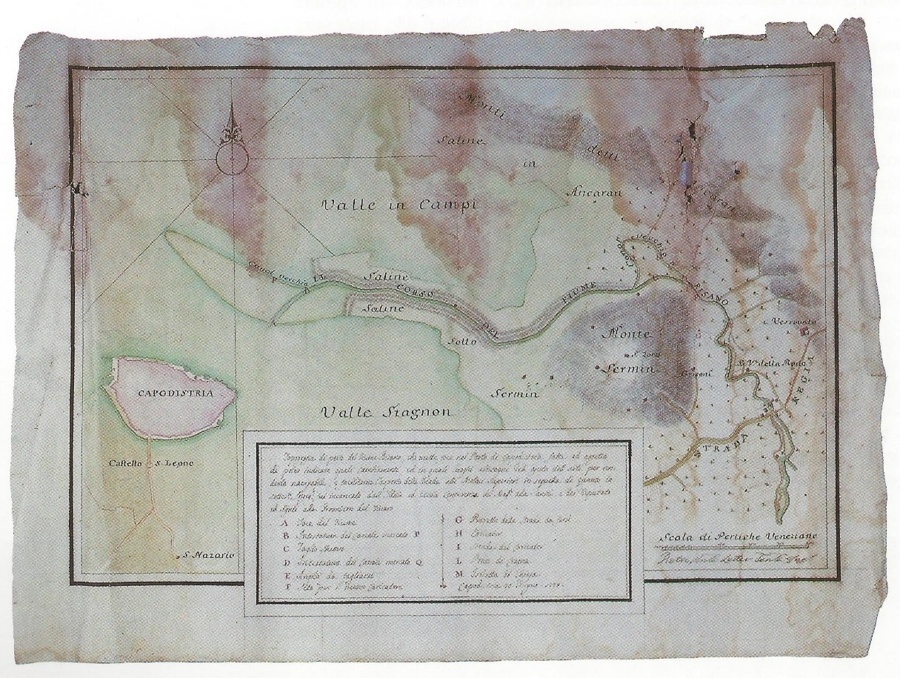
Historical sources also confirm that the name Ankaran once referred to a wider area. It apparently covered the territory from St. Catherine to the border with Škofije. This is evidenced by the map of the Koper bishop Naldini, as well as a plan of the Koper saltpans from 1774 by architect Petronio, where both Saline di Ancarano and Monti detti Ancarano are marked.
In the interpretation of place names, linguists emphasize the comparative method—examining where and how often the same or similar name appears—as well as the analysis of word roots. If we assume a Roman origin, the closest Latin or Italian root would be ancora, meaning anchor, which can also be understood as shelter or a small harbor. Interestingly, however, in the Abruzzo Ancarano—where geography offers no clear link to an anchor—the name is associated with the Etruscan-Picene goddess Ancaria, a protector against enemy invasions, to whom a temple was dedicated there.
The area of present-day Ankaran is naturally suitable for mooring boats and has long been associated with spiritual dedication. Although the direct transfer of the cult of the goddess Ancaria to the northern Adriatic is less likely, recent archaeological research confirms that the Adriatic region was strongly interconnected through trade and culture long before Roman dominance.
Regardless of the different interpretations, the name Ankaran carries within it the meaning of shelter and spiritual safety—a meaning that has been preserved in the space and its identity throughout the centuries.